San Francisco Architectural Guide
The Painted Ladies of San Francisco: A Guide to Victorian Homes
Where they are, what they are worth, and what it actually costs to own a piece of historic San Francisco real estate.
Painted Ladies: Essential Facts
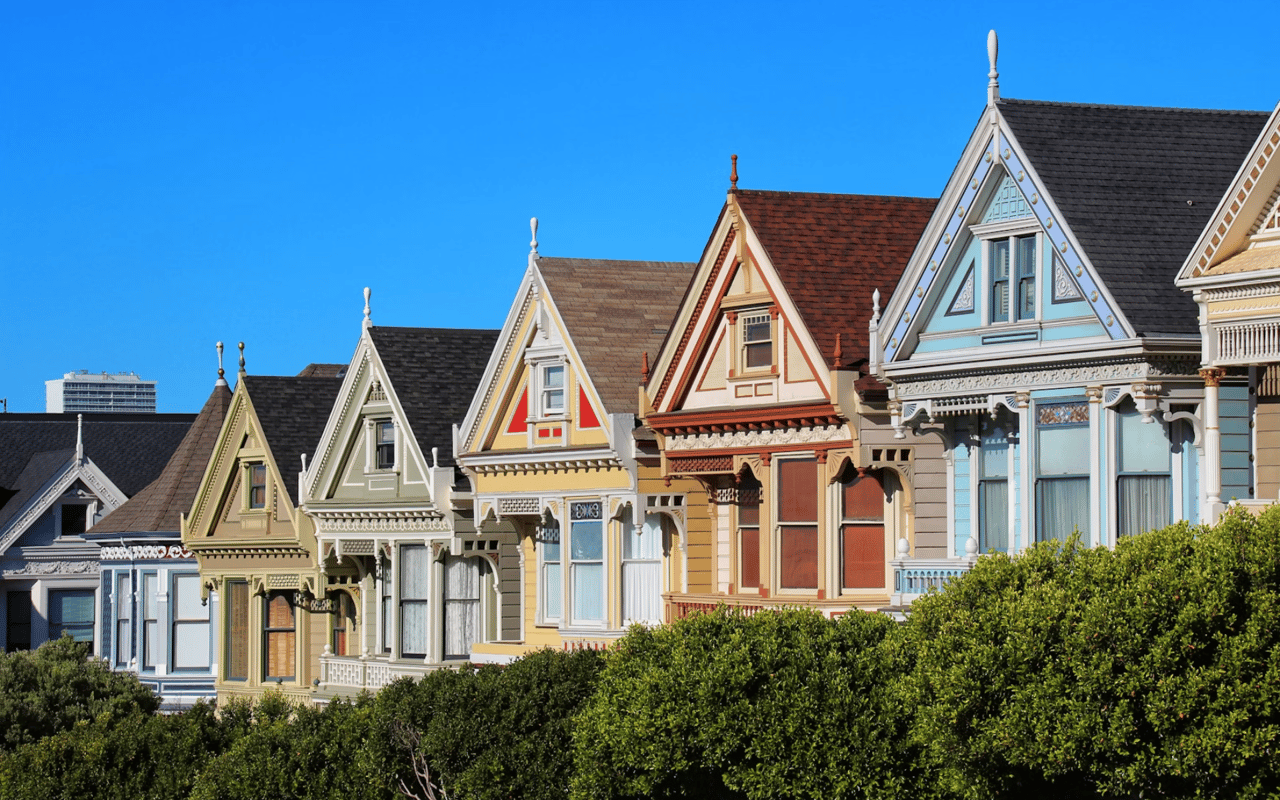
The Painted Ladies are located at 710-720 Steiner Street across from Alamo Square Park in San Francisco (ZIP 94117). Known as 'Postcard Row' and the 'Seven Sisters,' they are a row of seven Queen Anne-style Victorian homes built between 1892 and 1896 by developer Matthew Kavanaugh. The term 'Painted Ladies' refers to any Victorian or Edwardian home painted in three or more colors to accent architectural details. San Francisco features approximately 48,000 surviving Victorian and Edwardian homes built between 1849 and 1915. Homes in Alamo Square and the surrounding Western Addition currently range from $1.2M for unrenovated flats to $4M+ for fully restored single-family Victorian estates.
Interested in Homes Near Alamo Square?
Explore Preserved Victorian Real Estate Across San Francisco
Alamo Square, Pacific Heights, Haight-Ashbury, and Noe Valley feature some of the West Coast's most valuable historic inventory. Novo Real Estate tracks public listings and off-market Victorian opportunities across all classic SF districts.
Every year, millions of visitors photograph the Seven Sisters from Alamo Square Park. What most tourists do not realize is that those homes are privately owned residences embedded in a neighborhood where real estate fundamentals offer compelling opportunities for long-term investors and homeowners.
San Francisco contains approximately 48,000 surviving Victorian and Edwardian homes built during the city's rapid expansion between 1849 and 1915. While Postcard Row represents the most photographed six blocks of that inventory, the broader market includes thousands of architectural gems across the Western Addition, Pacific Heights, Mission District, and Noe Valley. Buying a Victorian in San Francisco requires understanding the asset class: architectural styles, seismic retrofit standards, restoration costs, and property tax incentives like the Mills Act.
San Francisco Victorian Architectural Styles at a Glance
San Francisco's historic homes span four distinct architectural eras, each featuring unique facades, framing structures, and renovation profiles.
Style | Historical Era | Signature Architectural Features | Valuation & Buyer Profile |
|---|---|---|---|
Queen Anne | Late 1880s - 1900 | Turrets, asymmetrical facades, decorative shingles, spindlework, steep gables | Highest buyer demand. Premium value for authentic period details. Typical Painted Lady form. |
Italianate | 1860s - 1880s | Flat roofs, symmetrical facades, heavy decorative brackets under eaves, tall narrow windows | Generous interior ceiling height (11ft-12ft+). Outstanding floor plan potential for modern layouts. |
San Francisco Stick | 1870s - 1890s | Rectangular bay windows, vertical board-and-batten lines, flat or slightly pitched roofs | Most common surviving Victorian type. Accessible price points across Western Addition and Noe Valley. |
Edwardian | 1901 - 1910 | Simpler exterior lines, understated ornamentation, wider footprints, expansive living spaces | Easiest to modernize. Less restrictive historic preservation review for interior/exterior updates. |
The Victorian Ownership Reality: Three Critical Buyer Factors
Owning a historic Victorian home in San Francisco is both a luxury lifestyle choice and a specialized asset management process. Here are three critical factors every buyer must evaluate:
1. Exterior Restoration & Paint
Authentic Painted Ladies utilize three or more colors to accent intricate woodwork and molding. Specialized exterior repainting for multi-story Victorians ranges from $30,000 to $60,000 every 10 to 15 years. In the Alamo Square Historic District, exterior color changes and woodwork repairs require review to ensure historic compliance.
2. Seismic Retrofitting & Foundations
19th-century Victorians were originally constructed on brick or unreinforced masonry foundations. Upgrading to a steel-reinforced concrete foundation, bolting sill plates, and completing soft-story seismic retrofits cost between $25,000 and $80,000+, protecting structural integrity and enhancing resale value.
3. Modern Luxury Meets Period Detail
San Francisco's highest-priced Victorians combine fully restored street-facing facades with open-concept interior floor plans, chef's kitchens, radiant floor heating, and smart home technology. Interior non-structural renovations generally do not trigger historic preservation restrictions.
Investor Insight: The Mills Act Property Tax Incentive
Certain historic homes in San Francisco qualify for the Mills Act, a California economic incentive program offering property tax reductions of 20% to 50% in exchange for a binding 10-year contract to preserve and maintain the home's historic exterior.
On a $3M to $5M Victorian purchase in San Francisco, annual property tax savings can range from $15,000 to $35,000+. Eligibility is administered through the SF Planning Department and is available for designated individual landmarks and contributing structures in historic districts like Alamo Square. Novo Real Estate connects buyers with qualified Mills Act preservation specialists. Contact our team for guidance.
Related San Francisco Market Resources
Frequently Asked Questions
Where are the Painted Ladies in San Francisco?
The Painted Ladies are located at 710-720 Steiner Street, across from Alamo Square Park, in the Western Addition neighborhood of San Francisco (ZIP 94117). Also called 'Postcard Row' and the 'Seven Sisters,' they are a row of seven Queen Anne-style Victorian homes built in the late 1800s. The best view is from Alamo Square Park looking east toward Steiner Street with the downtown skyline behind the homes.
Why are the Painted Ladies famous?
The Painted Ladies became nationally famous through the opening sequence of the TV series Full House (1987-1995) and the 1978 book 'Painted Ladies: San Francisco's Resplendent Victorians.' Their combination of colorful facades and Queen Anne architecture set against the San Francisco skyline made them iconic.
How much do homes near the Painted Ladies cost?
Homes in the Alamo Square neighborhood near the Painted Ladies currently range from approximately $1.2M for smaller fixer Victorian flats to $4M or more for larger, fully renovated single-family Victorians. Landmark properties in surrounding Western Addition areas can command $5M+.
What is the difference between Victorian and Edwardian homes in San Francisco?
Victorian homes (1837-1901) feature elaborate ornamentation, asymmetrical facades, and decorative detailing. Edwardian homes (1901-1910) feature simpler exterior lines, larger interior rooms, and less exterior ornamentation, making them generally easier and less restrictive to modernize.
What is the Mills Act and does it apply to San Francisco Victorians?
The Mills Act is a California property tax reduction program that allows owners of qualifying historic properties to pay property taxes based on income value rather than market value, often yielding 20% to 50% tax savings in exchange for a 10-year historic preservation agreement.
Find Your Victorian Masterpiece in San Francisco
Whether you are seeking a renovated Queen Anne near Alamo Square or a restoration opportunity in Pacific Heights, Novo Real Estate provides unparalleled access to public and off-market historic inventory.